Article
I Built a Read-Only Copy-Trade Alert Bot on StalkChain Data. Here Is How It Works and How to Make Money From Data in the AI Era
Disclosure: this post contains my StalkChain invite link. If you sign up and use it, I get usage credits. Nothing here is financial advice.
TL;DR
- In the AI era, models are cheap and everyone has them. Good data is the edge.
- StalkChain Data gives your AI (via MCP) social-trading data: trader handles resolved to real wallets, PnL, leaderboards, who holds what, and a live alert feed.
- I used that idea to build
copybot, a read-only Telegram alert bot that watches 27 verified Solana wallets of top traders and pings me when they buy or sell. - I never let it trade. It only alerts, and logs "paper" trades so I can test before risking money.
- Try StalkChain here: https://stalkchain.com/r/TB8T7YR
Why data matters more than the model
Anyone can call a strong LLM today. If you and a thousand other people give the same model the same public price chart, you get the same average answer.
The edge comes from data others do not have, or cannot structure quickly. Example: "Which wallet belongs to the trader @alpha, and what did that wallet buy in the last 30 minutes?" A chart cannot answer that. A labeled, wallet-resolved dataset can.
That is what StalkChain Data sells: social-trading data your AI can query directly through MCP.
What StalkChain gives you
From the tools I use and read about in the MCP server:
- Trader handles resolved to real Solana and EVM wallets, with PnL by time window
- Leaderboards (spot and perps) and per-trader reports
stalkchain_fomo_kol_holders: how many tracked traders hold a tokenstalkchain_fomo_multi_trader_entries: several traders entering the same tokenstalkchain_fomo_kol_sell_pressure: share of holders that already sold- On-chain safety checks (
stalkchain_token_onchain): mint/freeze authority, top-10 concentration, snipers, deployer history stalkchain_wallet_decode: is a wallet skilled or just lucky
Example question you can ask your AI in plain language: "Which tokens did 3 or more top traders enter in the last hour, and are the early holders already selling?" Without wallet-resolved data, this takes hours of manual work. With it, it is one question.
My real setup: a read-only copy-trade alert bot
I wrote a small Python bot (copybot, repo: LaBanHSPO/moneybooster). Design rule number one: it never trades, never signs, never touches a wallet key. Live trading code exists but is hard-locked.
How it works
- I picked traders that appear on both the 7-day and 30-day leaderboards. Consistency over one lucky week. That gave 30 traders, of which 27 Solana wallets were verified on-chain.
- Every ~10 seconds the bot polls those wallets via Solana RPC and parses swaps (token in, token out, USD size).
- It enriches each swap with DexScreener data (market cap, liquidity, buy/sell counts).
- If the trade passes my filters, it sends a Telegram card with a Copy button that opens the coin so I decide whether to buy.
My filters
Filter | Value | Why |
|---|---|---|
Trader's trade size | $50+ | Ignore dust and test buys |
Market cap | $50k+ | Skip brand-new junk |
Liquidity | $40k+ | I must be able to exit |
Stables/SOL/LSTs | ignored | Not "coins to copy" |
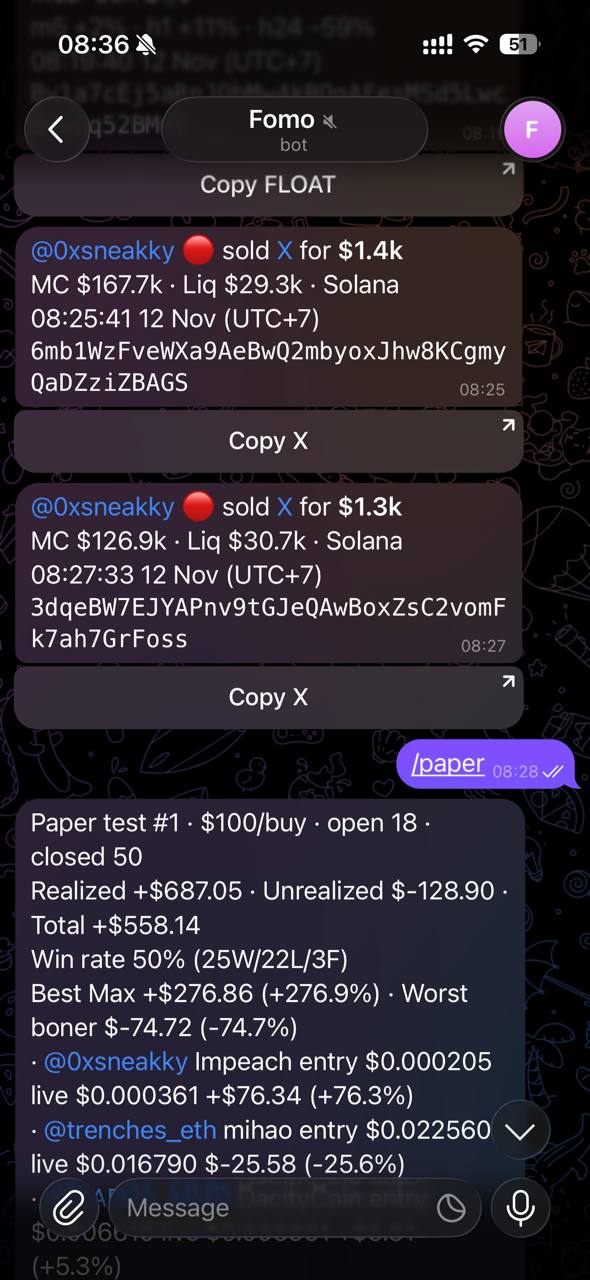
A real card from my bot (12 Nov, token name shortened):
@0xsneakky 🔴 sold X for $1.4k
MC $167.7k · Liq $29.3k · Solana
08:25:41 12 Nov (UTC+7)
[Copy X]
Buy cards look the same, with a 🟢 and an extra quick-score line.
The "breaking" signal. If 3 or more tracked traders buy the same coin within 30 minutes, the bot sends a 🚨 BREAKING card and can POST to a StalkChain screening webhook for scoring. It re-alerts only when the score is 6 or higher, and does not re-score the same coin for 2 hours unless the number of buyers doubles. Fewer repeated alerts means I actually read them.
Quick score (0 to 10). Free, instant, informational only. It penalizes thin liquidity, sells outnumbering buys, coins already up 100%+ in an hour (late entry), and coins under 1 hour old. It rewards healthy liquidity/market-cap ratio and many traders entering together. It never blocks a card, because I want to see everything and judge myself.
Paper trading. Each valid buy card opens a fixed-size paper position (currently $100 per buy). When the same trader sells, the paper position closes. This is how I measure whether following these wallets would have worked before I use a cent. Note that it uses mid-price, so it ignores slippage. Real results will be worse.
My paper results so far (Paper test #1)
This is the /paper command output from my bot on 12 Nov:
Metric | Result |
|---|---|
Size per buy | $100 |
Positions closed / open | 50 / 18 |
Realized PnL | +$687.05 |
Unrealized PnL | -$128.90 |
Total | +$558.14 |
Win rate | 50% (25 wins, 22 losses, 3 flat) |
Best trade | +$276.86 (+276.9%) |
Worst trade | -$74.72 (-74.7%) |
What I take from this, and what I do not:
- A 50% win rate is fine when winners are bigger than losers. The best trade made +$276.86 while the worst lost -$74.72. The profit comes from a few big winners, not from being right most of the time.
- Losers can be ugly. One position lost almost 75%. This is why liquidity and size limits matter.
- Examples from the list: a position copied from @0xsneakky was at +$76.34 (+76.3%), while one copied from @trenches_eth was at -$25.58 (-25.6%). Same method, opposite outcomes.
- It is still a small sample and uses mid-price with no slippage. Treat +$558 as "promising, not proven." Real fills on thin-liquidity coins will be worse, and I plan to keep the test running before putting real money behind it.
How to replicate it (30 minutes)
- Create a StalkChain account and connect it to your AI client over MCP: https://stalkchain.com/r/TB8T7YR
- Ask your AI: "Show the fomo leaderboard for 7d and 30d and list traders present in both."
- For each trader, resolve wallets and verify they actually trade on-chain (
stalkchain_fomo_trader_report,stalkchain_wallet_decode). - Save the list to
data/selected.json, create a Telegram bot with @BotFather, and put the token in.env. - Run on a cheap VPS (1 vCPU, 1 GB RAM is enough) with systemd. Use a paid Solana RPC for 24/7 because public nodes time out.
- Send
/startto your bot (you become the owner), then use/status,/traders,/paper,/filters min_liq 30000. - Run it in paper mode for at least 2 weeks. Only then think about acting on cards manually.
Security basics: no private keys in .env, chmod 600 .env, one bot process per Telegram token (two processes cause a 409 error).
How to actually make money in the AI + data era
I will be direct: copying trades is not a guaranteed income, and many traders on leaderboards were lucky. Here are the paths I think are more realistic, from lowest to highest risk:
- Sell the tool, not the trade. Package a niche alert bot or dashboard (for example "whale and KOL tracker for Telegram communities") as a subscription. Your revenue does not depend on market direction.
- Content and research. Weekly reports like "tokens entered by 3+ top traders, with sell pressure and on-chain safety flags." Data-backed posts earn trust, audience, and referral income. StalkChain even pays credits for posts (Reddit $20, blog $30, short video $40, YouTube $100).
- Due diligence as a service. Use safety and deployer checks to screen tokens for others (communities, funds, creators) and charge for the report.
- Disciplined manual trading with alerts. Use alerts as a filter, not a trigger. Check liquidity, concentration, and sell pressure first. Size small. Predefine exits.
- Automated trading. Highest risk and most work. Build it only after months of paper results, with hard loss limits and a dedicated hot wallet.
A hypothetical example of path 4: a card says a trader bought a coin that is already +180% in 1h. My quick score drops it to 4/10 with "pumped, late entry." I skip it. That one filter is where the value is: avoiding bad entries, not catching every winner.
My honest review
Good
- Wallet-resolved trader data is hard to build yourself. It saves weeks.
- MCP means my AI can query data in natural language, no custom scraping.
- One data source covers trader research, token holders, and on-chain safety.
- Works well as the input layer for your own automation.
Watch out
- Free credits run out fast if you loop calls. Cache results and use the cheapest tool that answers.
- Data shows what traders did, not whether it will work next. Past leaders regress.
- On Solana memecoins, you can be late by seconds to minutes. Liquidity filters matter.
Risk reminder
Crypto and memecoins can go to zero. Alerts are not signals to buy. Test with paper trading, never risk money you cannot lose, and do your own research.
Try it
If you want to build your own version, start here: https://stalkchain.com/r/TB8T7YR
Questions or want the filter settings I use? Leave a comment.